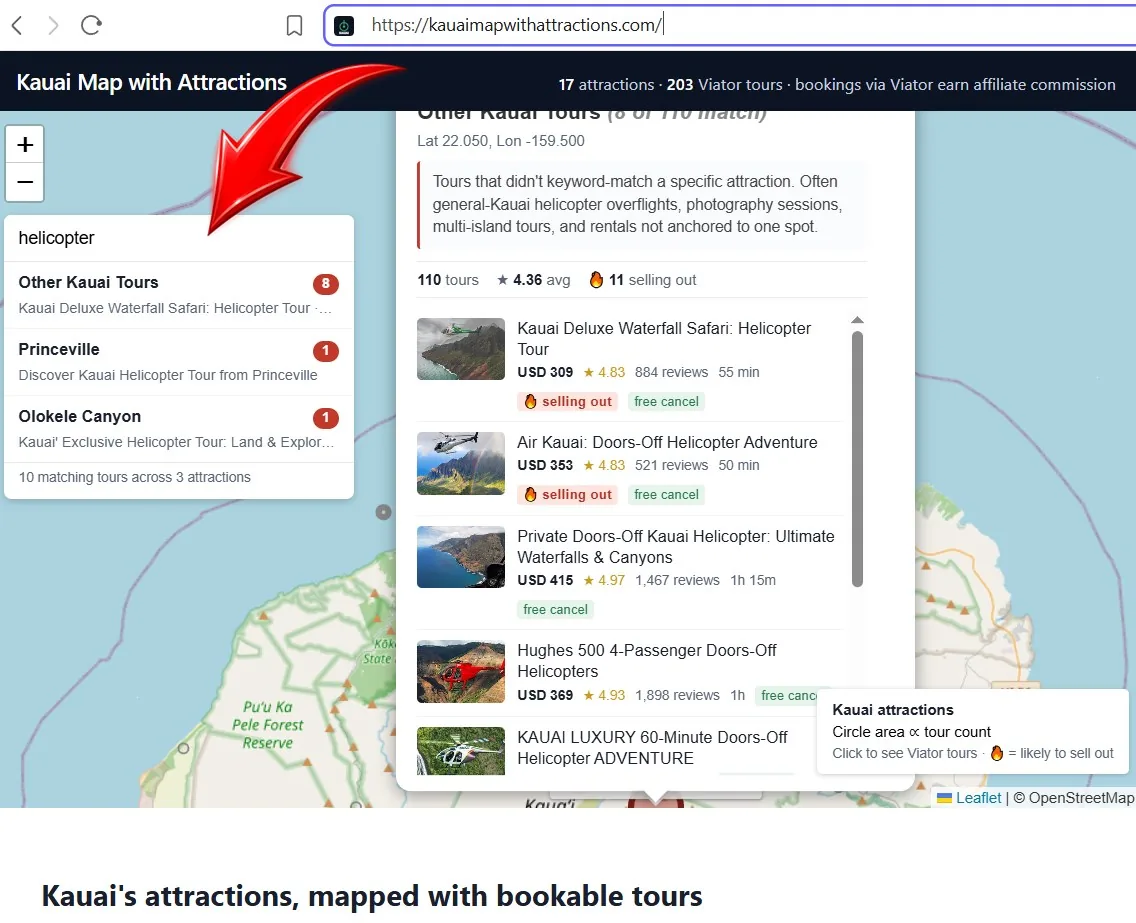
Why Kauai is the Hawaiian island for a helicopter tour
The interior of Kauai is mostly inaccessible. Mt. Wai’ale’ale, the 5,148-foot rain-fed crater at the island’s center, has no road and no maintained trail. The Na Pali Coast has no road for 17 miles. The 11 miles of Kalalau Valley behind Na Pali has no permitted day-use access past mile 6 of the trail. Three-quarters of the island that visitors most want to see is gated by terrain, weather, and conservation. A 50-minute helicopter flight from Lihue Airport sees more of Kauai than a five-day driving itinerary will.
The standard Kauai helicopter tour is a single circuit: northeast over Wailua Falls, west along the Na Pali Coast, south over Olokele Canyon and Waimea Canyon, then back north over the inland Wai’ale’ale crater (the “Weeping Wall” inside the eroded caldera) and the Hanalei Bay coastline before returning to Lihue. The route is FAA-published and varies only slightly between operators. The format choice is what matters: doors-on, doors-off, or land-and-explore.

Doors-on, doors-off, and land-and-explore
The decision tree:
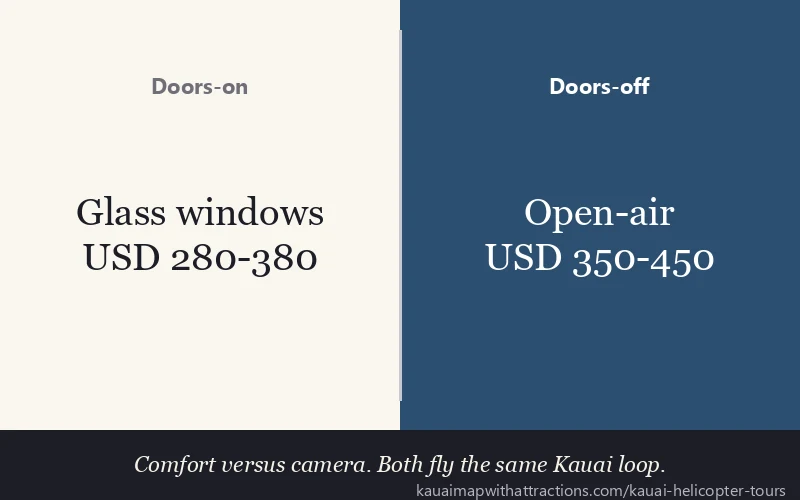
- Doors-on (standard A-Star or Eurocopter, glass-window flight). Quietest, most comfortable, four to six passengers. Suitable for travelers nervous about flying or sensitive to wind. USD 280-380 for 50-60 min.
- Doors-off (usually four-passenger Hughes 500 helicopters with the doors removed). Photographers’ format. Constant 80+ mph wind in flight; everything must be tethered (cameras on neck-straps, no loose clothing or hats). Worth the extra USD 70-100 for camera work and the visceral feel of the crater wall five hundred feet away. USD 350-450.
- Land-and-explore (the FAA-permitted private landing at Olokele Canyon’s interior). 90-minute total flight time including a 20-30 minute on-the-ground walk inside the canyon. The canyon walls reach 2,500 feet from the floor; you stand at the bottom looking straight up. Single permitted operator, limited daily slots, USD 400-550.
Most first-time Kauai helicopter passengers pick doors-on for comfort. Returning passengers and serious photographers pick doors-off. Travelers with one Kauai day and a flexible budget pick land-and-explore.
What the standard route shows you
In 50-60 minutes, the standard FAA-published Kauai loop covers what would take a full week of driving:
- Wailua Falls (the 80-foot twin falls used in the Fantasy Island opening), often the first stop after Lihue takeoff.
- The Hanalei coastline and Na Pali’s east end, with frequent stops at Hanakapi’ai Beach if the route swings close.
- The Na Pali Coast in full, often passing 200-300 yards from the cliff face. The most photogenic 6 minutes of the tour.
- Olokele Canyon (south of Waimea), narrower and less-visited than Waimea Canyon proper.
- Waimea Canyon from the air — a perspective the road-side lookouts cannot offer because you see the canyon’s full length and the cross-section of side gorges.
- Mt. Wai’ale’ale’s eroded crater — the “Weeping Wall,” with year-round waterfalls cascading down the 3,000-foot inner walls into the crater floor. This is the only way to see the crater from inside.
- Hanalei Bay and Princeville on the way back to Lihue.
The route compresses Kauai’s geographic diversity into a single arc. A first-day Kauai helicopter tour is also a survey for the rest of the trip: visitors point at the spots they want to revisit on the ground over the next four days.
Operators and aircraft formats
Most Lihue operators run one of three aircraft families:
- Eurocopter A-Star (AS350) — six passengers, doors-on, modern composite cabin, the comfortable workhorse. Each passenger gets a window. Used by most “premium” tours.
- Hughes 500D — four passengers, doors removable, the photographer’s helicopter. Smaller, lighter, more agile in maneuvers near canyon walls. Used by every doors-off operator.
- Robinson R44 — four passengers, doors-on, lower-cost aircraft. Used by a couple of operators for budget-tier tours; flies the same route slightly slower.
Ask which aircraft your operator flies before booking. The cabin geometry matters: an A-Star puts everyone within 18 inches of a window; a Robinson R44’s middle seat (rare on Kauai tours, but possible) is window-adjacent rather than window. Doors-off Hughes 500Ds have an open side rail; the seat-belt tether is checked at boarding and again before takeoff.
When to fly: weather, timing, and the morning advantage
The Kauai trade winds typically shift overnight, sit calm in the early morning, and pick up by mid-afternoon. Helicopter tours in the 7-10 a.m. window have the lowest cancellation rates of the day. By 1 p.m., the Hanalei coast and Na Pali sometimes see wind speeds above the 25-knot operating threshold, and operators routinely scrub afternoon flights.
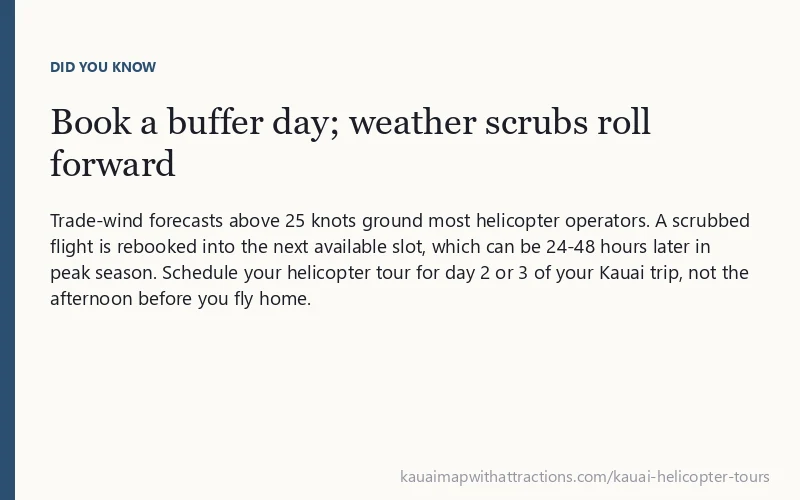
Build a buffer day into your itinerary. A scrubbed flight rolls forward to the next available slot, which on a busy week may be 24-48 hours out. Book your helicopter tour for day 2 or 3 of your Kauai trip, not day 6 (the last day’s afternoon flight that gets weathered out cannot reschedule before your departure).
The rainy half of the year (November-March) actually has competitive visibility for helicopter tours. Surprisingly, ground-tour visitors arriving at Waimea Canyon Lookout in winter often see a cloud floor below them; helicopters can fly above the same cloud and see the canyon clearly. The tradeoff is more frequent cancellations.

Things first-time helicopter passengers ask about
Motion sickness. Most passengers have no issues. The flight pattern is mostly smooth banking, not steep dives. Doors-off feels less nauseating than doors-on for many travelers because the open air provides a horizon reference. If you’re seasick-prone, take Bonine 30 minutes before boarding (it’s non-drowsy).
Photo quality. The window glass on doors-on flights is high-clarity, but it picks up reflections. Wear dark clothes (no white shirts), turn off interior cabin lights, hold the camera as close to the glass as you can without touching it. Doors-off eliminates this entirely. Camera straps must be neck-strapped to your body — operators check at boarding.
Weight restrictions. Most Kauai helicopters seat by passenger weight: heavier passengers go in front (better balance for the rotor), lighter in back. You’ll be weighed at check-in (sometimes including any camera bag). This is ungainly but standard FAA regulation, not operator capriciousness.
Children. Most operators allow age 2 and up. Ages 2-12 typically sit with a parent and pay a discounted (but still-charged) seat. No infant lap-seating; every passenger pays a seat fare. Doors-off operators usually require age 8 or 10 and up.
Headset and intercom. All passengers wear a headset with operator narration during the flight. Most operators record and stream the audio plus video; some sell the recording as an add-on (USD 25-50). Worth it if you have a special-occasion booking; skip if you’re flying for the experience itself.
Booking realism: how Viator inventory clusters
The Kauai helicopter market on Viator splits into clear bands:
- Doors-on, premium operators (USD 350-450): ~6 products, mostly A-Star aircraft, full Kauai loop, narrated by experienced guides. Sells out on busy weeks.
- Doors-off photo tours (USD 380-450): 4-5 products, all Hughes 500Ds, smaller groups. Books out fastest; reserve at least 2 weeks ahead in summer.
- Doors-on, budget tier (USD 280-340): 3-4 products, often R44 or shared larger-aircraft slots. Same route, slightly less narration polish.
- Land-and-explore (USD 400-550): 1-2 products, single operator with FAA permission to land at Olokele.
- Specialty (sunset / longer tours): smaller set of variants — 75-90 minute tours that add Niihau side trips or extended Hanalei coast time. USD 450-650.
If you want the doors-off photo tour and your dates are within 2 weeks of arrival, check daily — cancellations open up regularly because of weather rebookings cascading.
Sources
- Federal Aviation Administration: Hawaii Air Tour Common Procedures Manual (defines the Kauai routing, altitude minimums, and shoreline-distance rules).
- Hawaii Department of Transportation Aviation Division: Lihue Airport (LIH) operational data.
- US Geological Survey: Mt. Wai’ale’ale rainfall and crater geomorphology.
- Operator-published aircraft specifications cross-referenced via FAA registration data and the Viator listings on this map.